In many buildings and organisations, managing inbound deliveries falls to the reception team. It can take up a surprising amount of time and pull reception away from the rest of their responsibilities, such as greeting visitors, answering the phone and managing access.
How deliveries are handled varies from one building to the next. Below are the three approaches we see most often, and where each one falls short.
The no record approach
The simplest option is not to record the item at all. A parcel arrives, the receptionist phones the recipient to say there is something waiting, and when they come down it is handed over.
This is fast and works for a very small office with few deliveries. But there is no audit trail whatsoever. If an item goes missing, there is no way to establish whether it ever arrived, who took it or when. Disputes with couriers become impossible to resolve, and any item of real value is handled on trust alone.
The manual log
The next step most buildings take is to record items by hand, in a logbook or an Excel spreadsheet. When a parcel arrives, the receptionist notes the date and time, the courier, the recipient and a description of the item. The recipient is then notified by email or phone, and when they collect, they sign the book or the item is marked as collected in the spreadsheet.
This is a genuine improvement. You have proof of delivery, which matters enormously when something goes astray, and it creates accountability at both ends.
The problem is time. Logging every item by hand is slow and takes the reception team away from other work. Finding old records is slow too, and manual entries often have missing information or typing errors.
A digital approach: OmniPost
OmniPost is a delivery management system used by reception teams across the UK, in sectors such as corporate offices, education and healthcare. It does the same job as a manual log, but removes most of the effort from both logging and retrieval.
When an item arrives, the receptionist scans its barcode and selects the recipient, and OmniPost records the date and time, the courier and the recipient automatically. There’s no handwriting to decipher and no fields to retype.
Once the item is logged, OmniPost notifies the recipient straight away. If they don’t collect within a set timeframe, reminder emails are sent automatically, so chasing people to collect their parcels is no longer the receptionist’s job.
At collection, the recipient signs for the item on a mobile device. That completes the audit trail and gives the reception team proof of delivery for everything they have accepted from a courier and handed on.
Why the audit trail matters
Proof of delivery tends to be underestimated until it’s needed. When an expensive or time-critical item goes missing, the question is always the same: did it arrive, and if so, what happened to it next?
With a paper log, answering that can mean leafing through pages of handwriting. With a searchable record, it takes seconds. You can pull up every item received on a given date, everything from a particular courier or everything addressed to a named recipient, and see exactly where the chain broke.
Going further: smart lockers
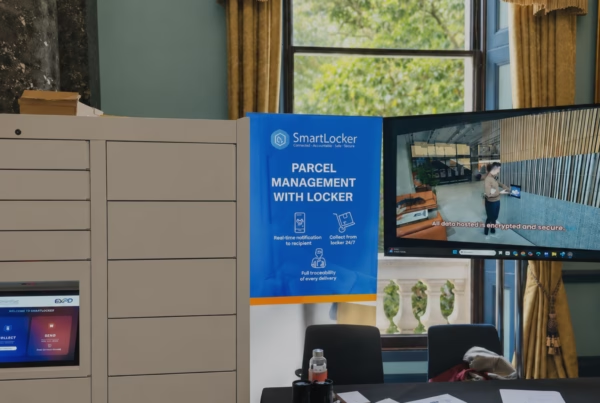
For buildings with a high parcel volume, smart lockers can take the process a step further.
A logged item is placed straight into a locker, and the recipient collects it with a code or their access badge, where integrated with the building’s access control at whatever time suits them. Reception is no longer tied to collection hours, parcels stop piling up behind the desk, and both the drop-off and the collection are recorded automatically. For buildings with shift-based staff, lockers can remove most of the workload.
In summary
Not recording parcels is quick, but it leaves you exposed when something goes missing. A manual log gives you accountability, but it costs your reception team time. A digital system like OmniPost keeps the accountability and removes most of the effort, and smart lockers can take reception out of the collection process almost entirely.